01. Pathophysiology and a Paradigm Shift: Tissue Health vs. Volumization
- Anatomical Basis: From age 25 onward, endogenous collagen production decreases by approximately 1% per year, and fibroblasts enter progressive senescence (Shin et al., 2023). This compromises the structure of the dermal scaffold and thins the extracellular matrix.
- Clinical Impact: It helps prevent overcorrection and an overfilled appearance while preserving natural facial movement (Swift et al., 2021).
| 💡 KEY MESSAGE “Adding volume without improving tissue quality only accentuates aging. The current goal is not to stretch tissue with volumizing fillers or relax the muscles, but to restore dermal cytoarchitecture and recover tissue density, firmness, and elasticity at their source.” |
02. Biological Dynamics: Improving Texture, Tone, and Firmness
Physiological Mechanism:
- Neocollagenesis: The gradual replacement of type III collagen fibers with type I collagen, which is structural and highly resilient.
- Elastogenesis: Renewed synthesis of elastic fibers to restore the tissue’s resilience and flexibility (Nowag et al., 2022).
- Extracellular Matrix Homeostasis: Sustained increase in glycosaminoglycan synthesis (endogenous hyaluronic acid), optimizing skin turgor and epidermal barrier function.
| 💡 KEY MESSAGE “Working on tone, texture, and firmness is not a superficial cosmetic change; it is a direct intervention in the cellular microenvironment to slow senescence and reactivate the skin’s protein synthesis.” |
03. Anatomical Overview and the Mechanism of Biostimulators
- Mechanism of Action: Deep dermis and the immediately adjacent subdermal plane. This anatomical region contains the highest density of dormant fibroblasts and the primary structural support network.
Cellular Mechanism of Action:
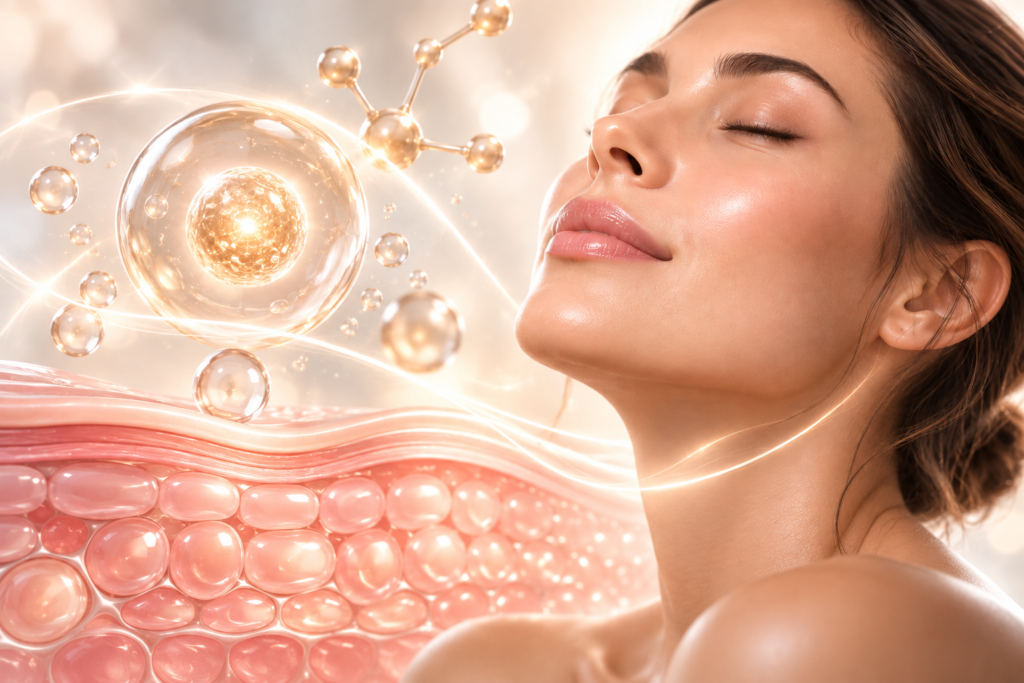
1. Deposition and Mechanotransduction: The biostimulator microparticles (such as poly-L-lactic acid or calcium hydroxyapatite) are deposited in the dermal extracellular space, creating mechanical traction on fibroblast membrane receptors (Aguilera et al., 2023; Avelar et al., 2024).
2. Controlled (Subclinical) Inflammatory Cascade: A physiological immune response mediated by macrophages is activated, releasing tissue growth factors.
3. Activation and Transdifferentiation: Dormant fibroblasts activate and begin secreting new procollagen, gradually restructuring the dermal matrix over several months.
| 💡 KEY MESSAGE “Biostimulators do not work by filling space; they act as a direct biological stimulation signal in the deep dermis, prompting cells to produce their own high-quality collagen.” |
References (APA 7th edition)
Aguilera, S. B., McCarthy, A., Khalifian, S., Lorenc, Z. P., Goldie, K., & Chernoff, W. G. (2023). The role of calcium hydroxylapatite (Radiesse) as a regenerative aesthetic treatment: A narrative review. Aesthetic Surgery Journal, 43(10), 1063–1090. https://doi.org/10.1093/asj/sjad173
Avelar, L. E., Nabhani, S., & Wüst, S. (2024). Unveiling the mechanism: Injectable poly-L-lactic acid’s evolving role—insights from recent studies. Journal of Cosmetic Dermatology, 24(1), e16635. https://doi.org/10.1111/jocd.16635
Nowag, B., Deininger, C., & Sattler, G. (2022). Calcium hydroxylapatite microspheres activate fibroblasts through direct contact to stimulate neocollagenesis. Journal of Cosmetic Dermatology, 22(9), 2415–2423. https://doi.org/10.1111/jocd.15521
Shin, S. H., Lee, Y. H., Rho, N. K., & Park, K. Y. (2023). Skin aging from mechanisms to interventions: Focusing on dermal aging. Frontiers in Physiology, 14, 1195272. https://doi.org/10.3389/fphys.2023.1195272